
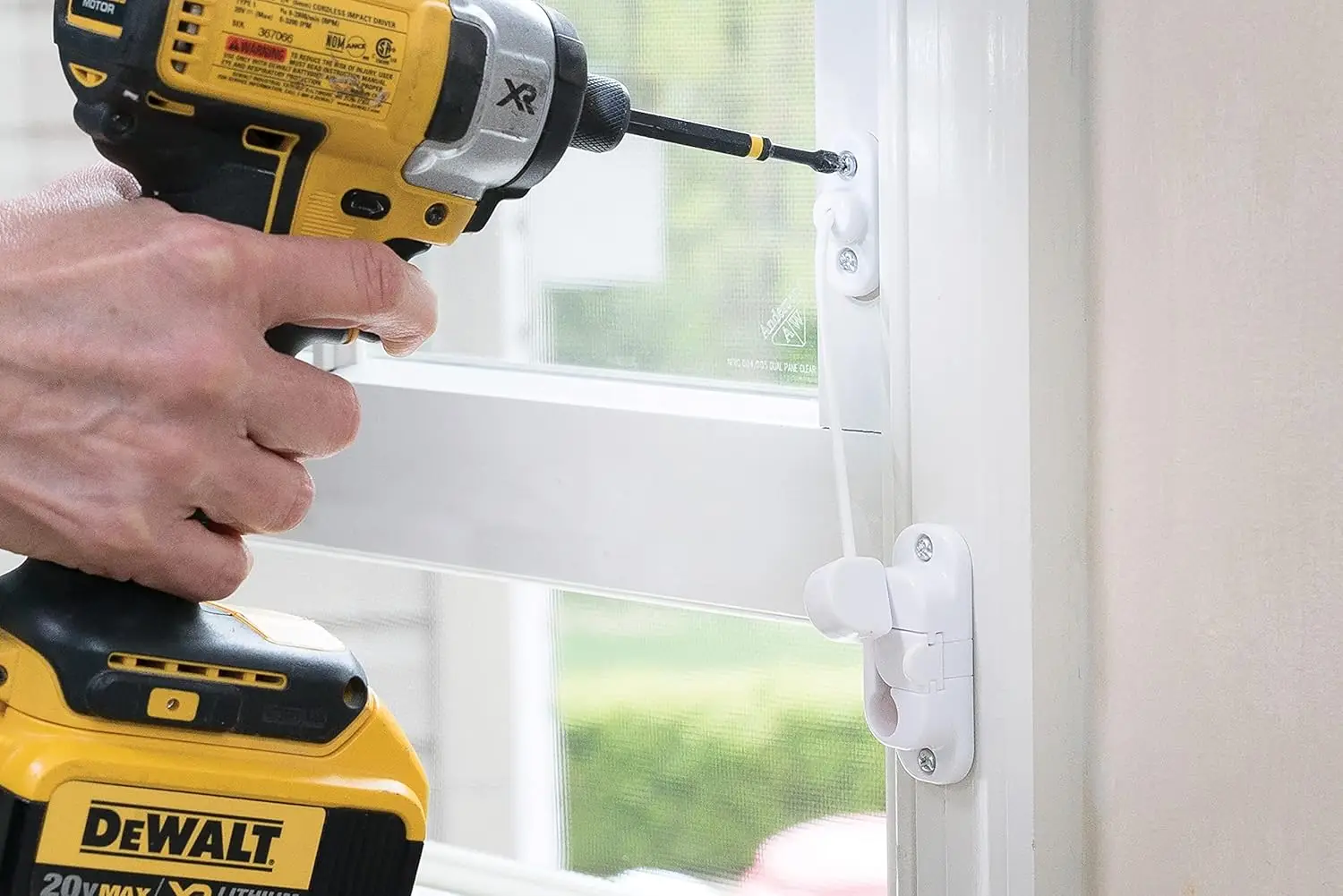
Parents are not short on information. Every pediatrician, hospital website, and safety checklist says the same things: anchor the furniture, gate the stairs, lock the cabinets. Parents read it, agree with it, and then stand in a hardware aisle or scroll through Amazon reviews with no idea which product will actually do the job in their house.
That gap, between knowing a hazard exists and fixing it correctly, is the part of baby proofing nobody talks about. This article is about the gap.
Recognizing the Hazard Is the Easy Part
An emergency room pediatrician can name the hazards that injure babies and toddlers from memory, because the same injuries come through the door every week. The Consumer Product Safety Commission publishes injury and fatality data gathered from hospital reporting. The Anchor It! campaign, pediatric organizations, and any number of reputable websites describe the risks accurately.
None of that is in dispute. If identifying hazards were the hard part, baby proofing would be solved.
Matching Hazards With a Product Solution Is Much Harder
Anchor It! tells parents to secure furniture and televisions to the wall. It does not tell them how to search for safety products that will do this properly. That is where parents get stuck, and it is where most do-it-yourself baby proofing quietly fails.
Furniture Anchoring & Manufacturer-Provided Kits
Most dressers and bookcases ship with a small anchoring kit: two plastic brackets, a plastic zip tie, and a pair of drywall anchors. Parents assume it is adequate. Why would the manufacturer include it otherwise?
Over the past eighteen months the CPSC has recalled tens of thousands of these kits. In April 2025, kits sold with chests and dressers at Rooms To Go were recalled because the plastic zip tie can become brittle or break. In October 2025, roughly 55,000 Cranach Hardware kits were recalled after CPSC testing found the plastic restraints failed ASTM F3096-23, the industry standard for tip restraints. Further recalls followed in 2026. In every case the replacement was stainless steel.
The kits fail because the job is harder than it looks. A piece of furniture that tips falls with a force greater than its own weight. It must stay secured not for a season but for years: according to CPSC data, 79 percent of furniture and television tip-over deaths involve children younger than six. Plastic does not hold up under that load for that long. The furniture brackets and anchors we install carry rated weight limits for exactly this reason.
Even the right product fails when it is installed incorrectly. When a handyman or contractor has anchored furniture before we arrive, the two mistakes we find most often are the same every time: the anchor is not attached to a stud, and the product itself was the wrong one for the job.
Baby Gates & Amazon Reviews
Gates are the clearest example of friction in the search for safety products. Most gates on the market will not work for most stairways. Only a small number will install properly and safely at the top of a staircase, and most parents have no way of knowing which ones, so they buy based on Amazon reviews. A gate with four thousand five-star reviews tells you it opens smoothly in a hallway. It tells you nothing about whether it can be mounted safely to your newel post.
That is where custom work begins. Many staircases have posts that no retail gate mount fits: oversized posts, masonry, wrought iron, decorative turnings. We make gate mounts for those cases ourselves. They cannot be purchased online for many post types, because they do not exist as a product. See what that looks like in our installation gallery and our guide to baby gate installation.
Cabinet Latches & Missing Hardware
Cabinet latches look interchangeable. They are not. Some cabinet constructions require a specific type of latch, and that type is sold only to professional baby proofers. Others use a retail latch that only works correctly with a screw set the manufacturer does not supply; we provide it and fit it on site.
The pattern is the same across all three: the product that works is often not the product a parent can find, and the installation that holds is often not the installation a general contractor will perform.
Why So Many Products Do Not Work
It is reasonable to assume that a product sold for child safety was designed by someone thinking about child safety. Often it was not.
A handful of companies make child safety products with the intention of keeping children safe. Most of what appears in an Amazon search comes from a different kind of company. Many are not manufacturers at all. They are sellers filling the demand a search term creates. Parents search for a baby gate, so someone lists a baby gate. The category is the business. The child is not.
I know this because I have asked. I have contacted these companies about specific shortcomings in the gates and latches they sell. Most never respond. The ones that do tell me they were not aware of the problem.
I cannot tell you what these companies know. Either they know their product will not work safely in most homes, or they have never cared enough to find out. For the parent standing at the top of the stairs, the result is the same.
The model depends on parents not knowing the difference. A gate that is wrong for the staircase looks fine in the box and fine in the listing photo. Most parents cannot tell a safe installation from an unsafe one, and nobody has ever given them a way to learn. The ones who suspect something is wrong are too busy and too overwhelmed to send it back. The gate stays on the stairs and the five-star review stays on the listing.
That is the market parents are shopping in. Finding the correct product in it is not a matter of reading more reviews. For anything beyond the simplest doorway, the odds are against them.
What This Means
We have written separately about when professional baby proofing makes sense and when doing it yourself is reasonable. The short version, in light of everything above: doing it yourself is reasonable for some situations. It stops being reasonable the moment any time a post is not standard, or the moment the product in the box is the product you are relying on.
A professional baby proofing service exists to close the product gap. The consultation identifies the hazards, which is the easy part. The value is in what follows: selecting the specific product for your furniture, your walls, and your staircase, supplying the parts the manufacturer did not, making the parts that do not exist, and installing every one of them to a stud with the right fastener. Every gate, anchor, and latch we install is backed by a 5-year warranty.
Working With Safe Start Child
Families in Washington, DC, suburban Maryland, and Northern Virginia can schedule an in-home consultation and installation.
Families everywhere can book a Virtual Safety Session with a baby proofing consultant and receive the same Home Safety Plan and access to the same products.
To discuss your home, book an inquiry call or contact us.
Frequently Asked Questions
Are the anchor kits that came with my furniture safe to use?
Not reliably. Plastic tip-restraint kits have been recalled repeatedly since 2025 for breaking or degrading, and the replacements have been steel. If your furniture is secured with a plastic bracket and zip tie, treat it as unsecured until it has been replaced with a rated metal anchor installed into a stud.
Can I buy the gate mounts or latches you use?
For many staircase posts and some cabinet types, no. They are either custom-made for the installation or sold only to professional baby proofers. They are available to our virtual child proofing clients and, in the future, will be sold online in our Safety Shop.
When should I baby proof?
Most families begin before the child is mobile. Our guide on when to baby proof your home covers the timing.
Does this apply to rentals?
Yes. See our article on baby proofing rentals.
With the Right Product and the Right Screw,
Alisa