
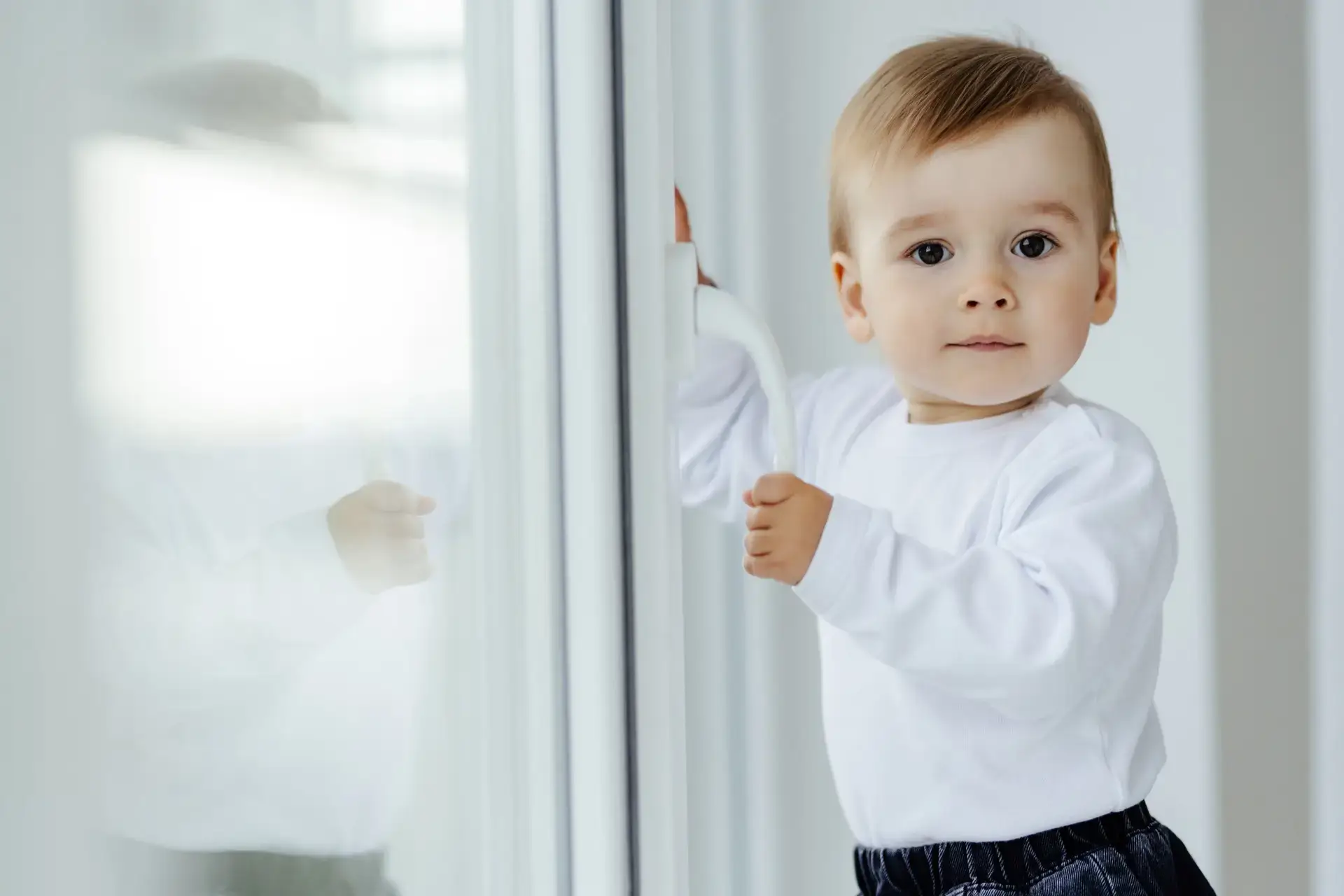
Most parents start thinking about baby proofing at the exact moment their baby does something new and mildly terrifying. They roll farther than expected. They reach the coffee table. They disappear from the play mat with the speed of someone who absolutely did not appear capable of going anywhere five minutes ago.
Then the panic-search begins: When should you baby proof your home?
The short answer is before your baby becomes mobile. The more useful answer is that baby proofing should follow your child’s abilities—not a date on the calendar.
Babies do not wait for us to finish ordering cabinet latches before they learn to open cabinets. They do not send a calendar invitation before pulling up on a dresser. And developmental milestones are not deadlines; children reach them on different timelines. The goal is to stay one step ahead of the next movement, not ten steps ahead of every theoretical risk.
Age Is Not the Real Deadline
Parents are often given age-based baby proofing advice: do this at six months, install that at nine months, worry about the stairs at one year. Ages can be helpful reference points, but they are not a safety plan.
The CDC describes developmental milestones as skills children develop in how they play, learn, communicate, act, and move. By around one year, for example, many babies are pulling up to stand or walking while holding furniture. Some children reach those movement milestones earlier. Others take their time and then surprise everyone at once.
That is why we recommend watching for changes in reach, strength, balance, speed, and curiosity. Those five things tell you far more about what your home needs than the number of months printed on a milestone chart.
Before Mobility: Use the Calm Window
Before your baby starts rolling across the room, you have something incredibly valuable: time to make decisions without a tiny person actively testing them.
This is the stage to look at the hazards that require planning or professional installation:
- Stairways and the type of gates each location requires
- Furniture, televisions, and appliances that need secure anchoring
- Window coverings with accessible cords
- Cabinets containing medicine, cleaning products, knives, or other hazardous items
- Rooms or exterior doors that may need restricted access
You do not need to install every latch in the house before your newborn comes home. You do want a plan for the items that are structural, high-risk, or difficult to solve in a rush.
It is much easier to evaluate a complicated banister while your baby is still stationary than while they are standing beside you, enthusiastically shaking it.
Rolling and Reaching: Look Low
Once a baby starts rolling, pivoting, reaching, or scooting, the usable area of the room changes quickly. Things that seemed safely out of the way are suddenly within range.
This is when we recommend doing a floor-level walkthrough of the rooms your family uses every day. Look for:
- Charging cords and lamp cords
- Blind or shade cords
- Low outlets and power strips
- Small objects that can be reached from the floor
- Unstable side tables or floor lamps
- Hot drinks, tablecloths, or decor near reachable edges
This is not about treating your home like a crime scene. It is about seeing the room from the perspective of someone with very little judgment and a deep commitment to putting unusual objects in their mouth.
Crawling: Access Becomes the Issue
Crawling changes baby proofing because your child is no longer limited to the area where you placed them. They can reach stairs, kitchens, bathrooms, fireplaces, pet areas, and rooms you did not realize were interesting.
At this stage, focus on controlling access:
- Secure the top and bottom of stairways with the correct child safety gates.
- Lock cabinets and drawers containing hazardous products or sharp items.
- Restrict access to rooms that cannot be safely supervised.
- Address windows, balconies, and exterior doors.
- Recheck cords, outlets, and low furniture in every frequently used room.
The type of gate matters. The U.S. Consumer Product Safety Commission advises using only gates that screw into the wall at the top of stairs and warns that pet gates should not be used as child safety gates. A pressure-mounted gate may look reassuring in a photo, but appearance is not the same as appropriate installation.
If the opening includes iron railings, an unusual banister, uneven trim, or extra width, the solution may require custom mounting. This is exactly where guessing becomes expensive—and sometimes unsafe.
Pulling Up and Cruising: Assume Everything Is Climbable
When babies begin pulling up to stand and moving along furniture, their relationship with the room changes again. A dresser drawer becomes a ladder. A television stand becomes a support surface. An oven handle becomes an excellent place to test body weight.
This stage is when anchoring becomes especially important. The CPSC recommends securing furniture, televisions, and appliances because children may climb on them, fall against them, or use them to pull themselves up.
Review:
- Dressers, bookcases, consoles, and shelving
- Televisions and media furniture
- Freestanding ranges and appliances
- Drawers that can be opened and climbed
- Tablecloths and objects near furniture edges
- Toilets, tubs, and other water access
- Windows that can be reached from nearby furniture
Do not assume that a heavy piece of furniture cannot tip. Toddlers are small, but they are impressively skilled at changing leverage.
Walking and Climbing: The First Plan Is Not the Final Plan
Walking creates speed. Climbing creates height. Together, they expose a new category of hazards that may not have existed when your child was crawling.
Door locks may need to move higher. Window access may change when a chair is pushed nearby. A cabinet that was ignored for months may suddenly become fascinating. Gates that worked well should be checked for fit, hardware, and everyday use.
This is why baby proofing is not a one-time installation. It is a system that should evolve with your child.
We recommend reassessing the home whenever your child reaches a major movement milestone and doing a broader review every three to six months during the most active toddler years. Also recheck after moving furniture, changing rooms, renovating, or bringing new equipment into the home.
If Your Baby Is Already Moving, Start Here
If you are reading this while your baby is crawling toward an unsecured staircase, take a breath. You are not behind forever; you simply need to prioritize.
Start with:
- Stairways and fall risks
- Furniture, television, and appliance anchoring
- Medicines, cleaning products, and sharp items
- Windows, blind cords, water, and exterior access
- The rooms where your child spends the most time
Do not try to complete a fifty-item checklist in one frantic weekend. Address the risks with the greatest potential for harm first, then build out the rest of the plan based on how your family actually uses the home.
Our Baby Proofing Checklist can help you identify the first priorities without treating every room and every risk as equal.
The Right Time Is Before the Next Milestone
So, when should you baby proof your home? Before your child’s next movement changes what they can reach, open, climb, or access.
That may be during pregnancy. It may be when rolling begins. It may be the day you realize your very determined ten-month-old can open the same latch you installed last week.
The important thing is to replace panic with a plan. For families in Washington, DC, Maryland, and Northern Virginia, our Custom Child Proofing service provides an in-home assessment and professional installation. Families everywhere can use a Virtual Baby Proofing consultation to receive a personalized Home Safety Plan.
No safety device replaces active adult supervision, and no home can be made completely risk-free. But thoughtful baby proofing can reduce common hazards and make everyday family life feel noticeably more manageable.
With Less Panic and a Better Plan,
Alisa