
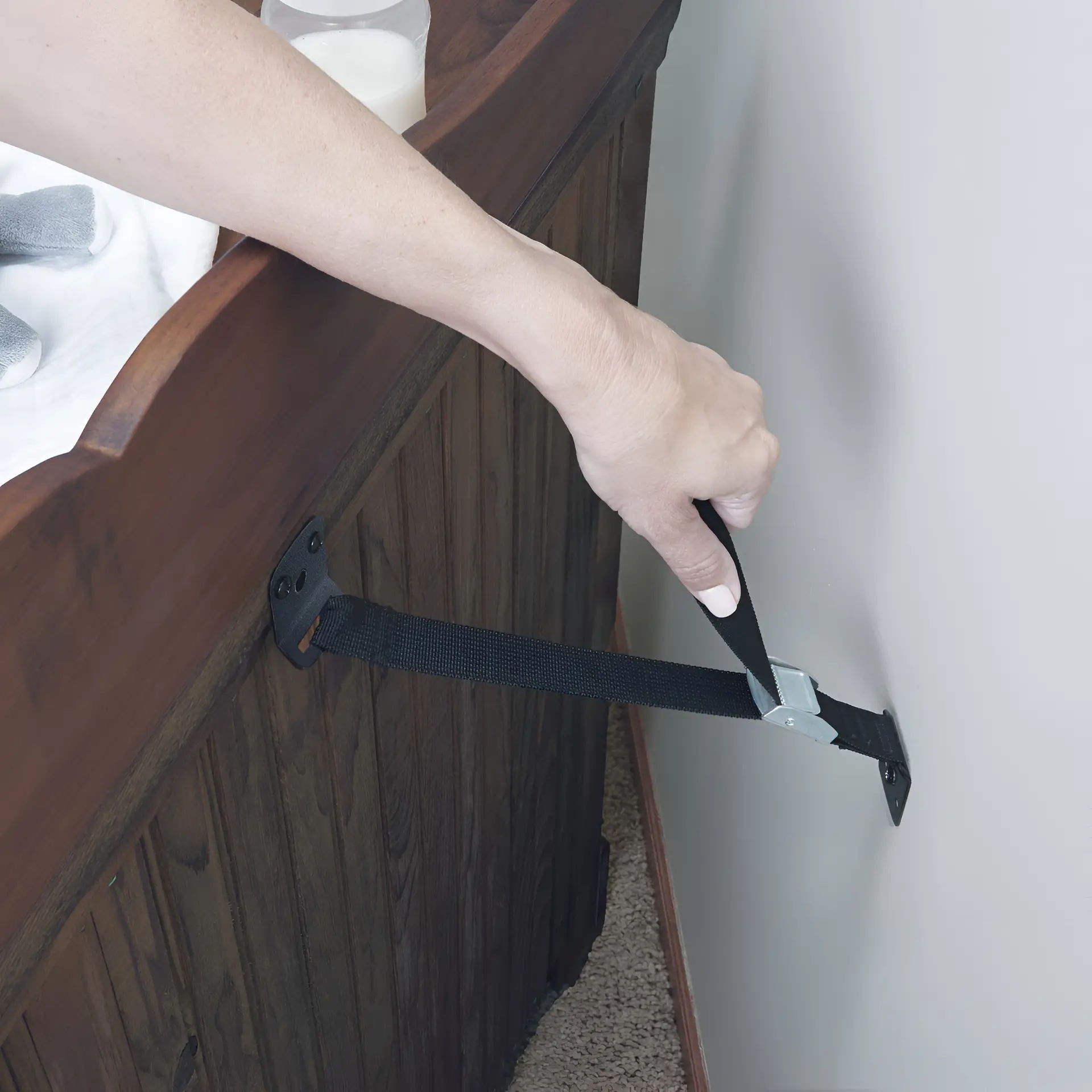
A dresser can feel completely immovable to an adult. To a toddler, it is a ladder with convenient pull-out steps.
That is the problem with furniture tip-over hazards: they rarely look dramatic before something happens. The furniture may be heavy, new, low to the ground, or sitting quietly in a room where a parent is always nearby. None of those things guarantees stability.
The U.S. Consumer Product Safety Commission recommends anchoring furniture, televisions, and certain appliances because children can be seriously injured when they climb on, pull against, or fall into unstable items. Tip-overs can happen quickly, including when an adult is in the same room.
Learning how to anchor furniture to a wall is an important part of baby proofing, but the correct installation depends on the furniture, the wall, the hardware, and the way the room is used. There is no universal strap-and-screw combination that works everywhere.
Why Heavy Furniture Tips
Parents often assume a dresser or bookcase is safe because it is difficult to move. But weight and stability are not the same thing.
When drawers or doors open, the center of gravity changes. When a child climbs, pulls up, or places weight on the front of the furniture, that force moves even farther forward. A television, decor, or stored objects can add weight high above the base.
Toddlers also behave differently around furniture than adults do. They use drawer pulls as handles, shelves as footholds, and the top of a dresser as a possible destination. They are small, but they are persistent and extremely comfortable with bad ideas.
Anchoring does not make climbing acceptable. It creates an added layer of protection if a child interacts with the furniture in a way no adult intended.
What Furniture Should Be Anchored?
Start with any item that could tip, fall, or pull away from the wall if a child climbs on it, opens it, bumps it, or uses it to stand.
Common priorities include:
• Dressers, chests, and bureaus
• Bookcases and freestanding shelving
• Wardrobes and tall storage cabinets
• Media consoles and television stands
• Desks, hutches, and freestanding cabinets
• Entry consoles and narrow accent furniture
• Large mirrors or heavy decorative pieces that are not independently secured
• Televisions, including televisions placed on anchored furniture
The nursery is not the only room that matters. Children climb furniture in bedrooms, playrooms, family rooms, home offices, guest rooms, and grandparents’ homes. If the child can reach the room, include it in the assessment.
Our Baby Proofing Checklist can help you place furniture anchoring within a larger, prioritized home safety plan.
Check the Furniture and the Wall
Before choosing furniture anchors, inspect both surfaces. Furniture anchors connect two different structures: the furniture and the wall. Both attachment points must be appropriate.
Before installing anything, identify:
• The furniture material and a strong attachment point on the item
• The wall material behind the furniture
• The direction and type of force the restraint is designed to handle
• Any baseboards, gaps, outlets, or other conditions that affect placement
Drywall, plaster, masonry, tile, wood paneling, and metal framing do not behave the same way. Solid wood furniture, particleboard, metal shelving, and hollow panels do not accept fasteners in the same way either.
If you are unsure what you are attaching to, stop and get guidance. An anchor is only as reliable as its attachment points.
How to Anchor Safely
The sequence below explains the decisions involved; it does not replace product-specific installation directions.
1. Use a restraint weighted for the item
Do not use the anti-tip device supplied with the furniture it, choose a compatible restraint designed for that type of furniture and expected load.
Do not use wall anchors. Always secure to a wall stud. Call a professional to secure furniture to masonry walls or steel studs.
Check the CPSC recall database before relying on an unfamiliar or older product, especially if the hardware was purchased secondhand or has been stored for years.
2. Find a strong point on the furniture
The furniture-side connection should attach to a structural part of the item, not a thin backing panel, decorative trim, loose top, or other component that may pull away.
Manufacturer instructions may identify the correct location. If they do not, or if the furniture construction is unclear, a professional installer can evaluate the piece and choose an appropriate method.
3. Match the wall hardware to the wall
The wall-side attachment must be suitable for the wall material and the restraint. A generic plastic drywall anchor is not appropriate because it came in a multipurpose hardware kit.
Some installations require attachment to wood framing or another structural material. Others use hardware specifically rated for a particular wall assembly. Plaster, masonry, tile, and metal framing often require different tools and techniques.
The correct decision depends on the specific product and surface, which is why one-size-fits-all instructions are unreliable.
4. Position the restraint correctly
Anti-tip restraints usually work best when installed near the top of the furniture and kept short enough to limit forward movement, but the exact placement should follow the manufacturer’s directions.
Account for baseboards and the gap behind the furniture. A long, loose strap may allow more movement before it engages. A twisted or poorly aligned restraint may not perform as intended.
The finished installation should not interfere with outlets, cords, ventilation, drawers, or other parts of the furniture.
5. Secure the television separately
Anchoring a media console does not automatically secure the television sitting on it.
The CPSC recommends mounting flat-screen televisions to the wall or securing them to the wall or appropriate furniture. If a television is not wall-mounted, use a restraint designed for that television and setup. Place televisions only on furniture intended to support them, and keep cords out of children’s reach.
6. Follow the installation instructions
Tighten and position all components as directed. Confirm that fasteners are fully seated, straps or cables are not damaged, and the furniture is level and functioning normally.
Do not use a forceful “test” that could damage the furniture, wall, or restraint. Instead, follow the manufacturer’s verification instructions and inspect for obvious movement, loose connections, or material failure.
Keep the instructions and note where the anchor was installed. That information becomes useful when the furniture is moved, walls are repaired, or the restraint needs replacement.
Remove the Reasons Children Climb
Anchoring is important, but it should not be the only strategy.
The CPSC recommends removing tempting items such as toys and remote controls from the tops of televisions and furniture.
Also consider:
• Keeping frequently used children’s items on low, accessible shelves
• Moving chairs, step stools, and toy bins away from climbable furniture
• Closing drawers and cabinet doors after use
• Using appropriate drawer latches when access creates an additional hazard
• Storing heavier objects in lower drawers or on lower shelves
• Keeping television and cable cords out of reach
• Toddlers will still climb. The goal is to avoid creating a perfectly arranged invitation.
Common Anchoring Mistakes
Most furniture anchor failures begin with a reasonable assumption that turns out not to be true.
1. “It is too heavy to tip”
Heavy furniture can become unstable when drawers open, when weight is added to the front, or when a child climbs. Assess the shape, height, base, drawers, doors, and likely child behavior rather than relying on weight alone.
2. Anchoring the furniture but not the television
The furniture and the television are separate objects. Both may need their own secure restraint.
3. Attaching to a weak furniture panel
Thin backing material and decorative trim can tear away before the restraint does its job. Use the manufacturer’s approved attachment point or have the construction evaluated.
4. Using whatever wall anchor is nearby
Fasteners and wall anchors are not interchangeable. Hardware must be appropriate for the wall material, connection, and load.
5. Treating adhesive as a no-hole equivalent
Adhesive products can be useful for low-consequence tasks when designed for that purpose. They are not automatically an appropriate substitute for a mechanical anti-tip connection.
6. Trusting “damage-free” marketing
“Damage-free” marketing can be appealing, especially in a rental, but avoiding a small repair is not the same as reducing a serious hazard.
7. Forgetting the anchor after moving furniture
Furniture is often pulled away from the wall for painting, cleaning, new flooring, cable work, or a room redesign. If the restraint is removed, it must be correctly reinstalled before the child uses the room again.
8. Anchoring only the baby’s room
Children do not respect the boundaries of a nursery mood board. Anchor hazards anywhere a baby or toddler may spend time, including relatives’ and caregivers’ homes.
Furniture Anchoring in a Rental
Renters often worry about making holes in the wall. That concern is understandable, but a no-hole solution is not automatically a safe solution.
Review your lease, document the proposed installation, and request written permission from the property manager or landlord when required. Explain that the hardware is an anti-tip safety measure and ask about wall construction or approved attachment methods.
Small, properly placed holes can usually be repaired when the restraint is removed. The exact process depends on the property and lease, so do not rely on a generic promise that every landlord will treat the work the same way.
If the property has unusual walls or does not permit a necessary installation, a Virtual Baby Proofing consultation can help you evaluate the space, understand the options, and prepare a clear plan to discuss with the owner.
When to Call a Professional Baby Proofer
Professional help is a good idea when:
• You cannot identify the wall or furniture material
• The furniture has no obvious structural attachment point
• The wall is plaster, masonry, tile, glass, metal, or another difficult surface
• The item is especially tall, heavy, valuable, or unusual
• The installation affects electrical wiring, plumbing, or an appliance
• A previous anchor pulled loose or damaged the surface
• You need the installation to be discreet in a highly finished room
There is no benefit in guessing through a high-consequence installation. A professional baby proofer should understand how safety, structure, usability, and appearance work together.
Furniture anchoring is not a one-time task that disappears from the list forever.
Frequently Asked Questions
Do new dressers still need to be anchored?
Yes. New furniture may include anti-tip hardware or be designed to meet current stability requirements, but the CPSC still advises consumers to install the provided restraint right away and follow the manufacturer’s instructions.
Can one anchor secure a dresser?
Use the number, type, and placement of restraints specified by the furniture or anti-tip device manufacturer. Do not reduce the hardware because the furniture feels stable or because only one connection point is convenient.
Are furniture anchors only for toddlers?
The risk often becomes more visible when babies begin pulling up and toddlers begin climbing, but anchoring should happen before those behaviors begin. Children also visit homes belonging to relatives and caregivers, so it is worth securing hazards even when no young child lives in the home full time.
Can supervision replace furniture anchors?
No. Active supervision is essential, but tip-overs can happen too quickly for an adult to stop them. Anchoring adds protection for the moment a child behaves unexpectedly, which is not exactly a rare event.
Safety Does Not Have to Stand Out
Good furniture anchoring is usually quiet. It sits behind the furniture, does its job, and allows the room to keep looking like a home.
That is the standard we use throughout modern baby proofing: secure, appropriate, durable, and integrated into the space. The goal is not to cover the room in products. It is to address the hazards that matter with solutions that hold up in real life.
Families in Washington, DC, Maryland, and Northern Virginia can use Custom Child Proofing for an in-home assessment, a customized Home Safety Plan, and professional installation. Families anywhere can use Virtual Child Proofing for expert guidance and a plan tailored to their home.
If you want help identifying what needs to be anchored and how to prioritize the work, contact Safe Start to schedule a consultation.
Dedicated to safer homes and fewer bad toddler ideas,
Alisa